Who wins German IT tenders: 94.9% go to German firms
We analysed 11,174 German public IT award notices on TED. Foreign firms rarely win because they rarely bid. Here is where Balkan firms do win, and a route into German public buyers.
In short
- German-registered firms won all lots in 94.9% of the German public IT award notices that name the winner's country, published on TED from January 2024 to October 2026.
- Foreign firms rarely bid for German public IT contracts: of 45,797 bids recorded in TED award notices since January 2024, 1.37% came from other EEA countries and 0.42% from outside the EEA.
- Western Balkan IT firms win public contracts mainly in Croatia, Slovenia and EU-funded tenders at home, while only one German public IT award notice named a Serbian winner.
German-registered firms won all lots in 94.9% of the award notices for German public IT contracts that name the winner's country [1]. The data covers 11,174 award notices for IT services and software published on TED, the EU's public procurement journal, from 1 January 2024 to 17 October 2026. Western Balkan firms appear as a winner in one of them [2].
Foreword
We built this dataset because we kept hearing the same sentence from founders in Belgrade and Podgorica: "German public buyers do not work with companies like us." We wanted to know whether that is a rule or a habit.
German public IT contracts go almost entirely to German-registered firms. But Balkan firms are not losing those tenders: they are barely entering them.
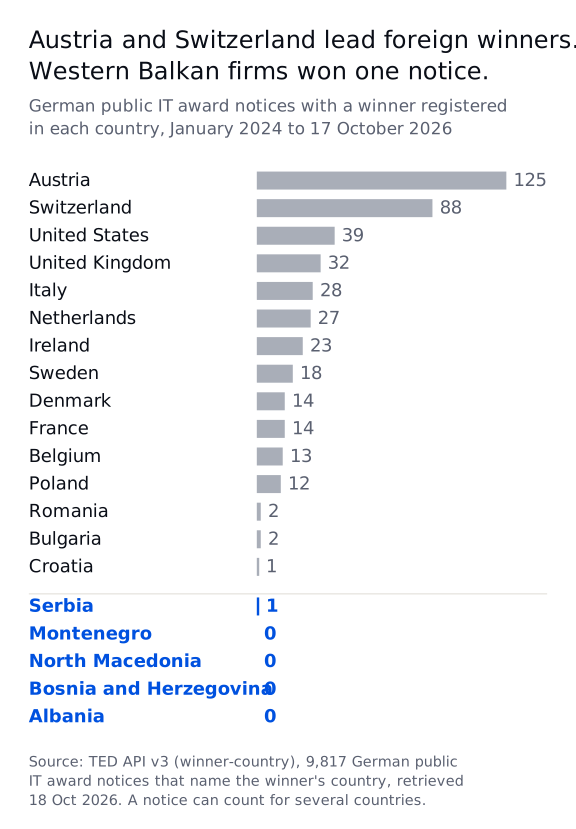
Between January 2024 and October 2026, only one award notice for IT work done in Germany named a Serbian-registered winner. No notice named a winner from Montenegro, North Macedonia, Bosnia and Herzegovina or Albania.
We think that is a go-to-market problem, not a quality problem. Serbia sold US$5.15 billion of ICT services abroad in 2025 [5], so the capacity to deliver exists. What is missing is the route in.
This paper sets out what the public record shows, where Balkan firms do win public IT contracts in Europe, and what a realistic route into German public buyers looks like.
Think as Tesla Editorial
Executive summary
TED lists 11,174 award notices for German public IT contracts above the EU thresholds, published from 1 January 2024 to 17 October 2026 [1]. In 94.9% of the notices that name the winner's country, every winner was registered in Germany. A Western Balkan firm appears as a winner in one: a Serbian software consultancy working for the energy company EnBW [2].
- German firms win almost everything. German-registered firms won all lots in 94.9% of notices that name the winner's country. Firms from other countries appear as a winner in 5.1%, led by Austria (125 notices) and Switzerland (88).
- Foreign firms rarely bid. Of 45,797 bids recorded, 1.37% came from other EEA countries and 0.42% from outside the EEA. Only 1.5% of the notices that record where bids came from received any bid from outside the EEA.
- Competition is thin. 45.5% of single-lot contracts received only 1 bid, and the median was 2 bids.
- Small and medium-sized firms win often. At least one SME was among the winners in 61.1% of notices with a recognised firm size.
- Balkan firms win next door. Where Western Balkan IT firms win public contracts in Europe, it is in neighbouring countries or with EU money at home: Bosnian firms in Croatia, Serbian firms in Slovenia and Croatia, and EU-funded tenders in North Macedonia, Montenegro and Bosnia and Herzegovina.
The data cannot show whether price or skill holds Balkan firms back. It does show that they rarely bid at all.
The first barrier is presence: a German-registered entity or partner, German-language bids, and a track record with buyers that already use foreign suppliers. The checklist at the end of this paper turns this into steps.
How big is the German public IT market?
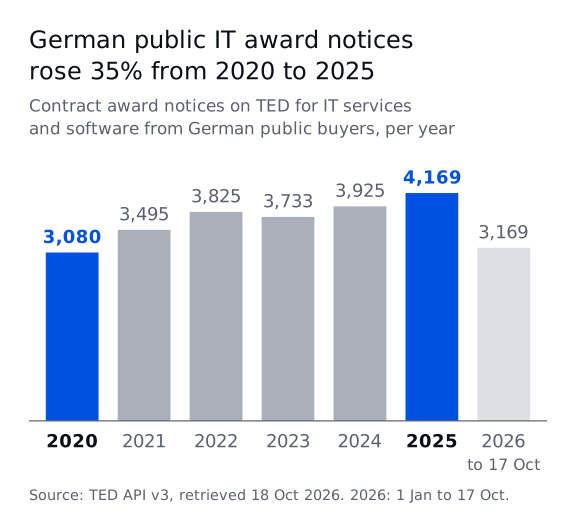
German public IT contracts produced 4,169 award notices in 2025, up from 3,080 in 2020 [1]. An award notice is the public record that a contract has been signed.
Each notice names the buyer, the winner and usually the value. Only contracts above the EU thresholds must appear on TED, so the data covers the upper part of the market.
Who buys IT in the German public sector?
General public administration placed 44.2% of the 11,174 German public IT award notices published from 1 January 2024 to 17 October 2026 [1]. Health placed 19.0%, education 9.3% and economic affairs 8.9%.
The largest single buyer is the procurement office of the Federal Ministry of the Interior, with 403 notices under two name variants. Next come the federal IT service centre ITZBund (223) and the Hessian state data centre (156).
| What was bought | Award notices | Share (%) |
|---|---|---|
| IT services only (CPV 72) | 5,817 | 52.1 |
| Software packages only (CPV 48) | 4,228 | 37.8 |
| Both | 1,129 | 10.1 |
What are German public IT contracts worth?
German public IT contracts have a median value of €629,280, where a value is reported [1]. Only 42.1% of notices report a usable total value in euros, so treat the figures as indicative.
The middle half of these contracts sits between €297,164 and €2,081,397. Framework agreements often report a maximum value, not what is actually spent.
For a small Balkan software firm, a single contract of that size can be a large share of a year's revenue. That is the scale this paper is about.
Who wins German public IT contracts?
German-registered firms won every lot in 94.9% of the German public IT award notices since January 2024 that name the winner's country [1]. Of those 9,817 notices, 9,315 went only to German firms. A foreign-registered firm appears among the winners in 502 notices, or 5.1%.
Which foreign firms win German IT tenders?
Firms from Austria (125 notices) and Switzerland (88) win German public IT contracts most often among foreign firms [1]. Together they appear in 212 of the 502 notices with a foreign winner, or 42.2%. Both countries are German-speaking, which helps when tender documents, questions and bids are handled in German.
EU members as a group appear 330 times and non-EU countries 182 times. A notice with winners from several countries counts once per country.
Poland appears in 12 notices, and Romania and Bulgaria in 2 each. The one Western Balkan entry is GeminiSix, a Belgrade software consultancy. It won a software licence-management contract from the energy company EnBW, in an award notice published in September 2025 [2].
Do foreign firms bid for German IT tenders?
Foreign firms rarely bid for German public IT contracts, so the low number of foreign winners is not mainly about losing [1]. Buyers record where bids came from, and 9,319 notices carry that breakdown.
Of the 45,797 bids these notices received, 629 (1.37%) came from other countries in the European Economic Area and 193 (0.42%) from outside it. Only 4.2% of these notices received any bid from another EEA country, and 1.5% received any bid from outside the EEA.
Those 193 non-EEA bids include Switzerland, the United Kingdom, the United States and every other non-EEA country. Bids from the Western Balkans can only be a small part of them. For a Serbian or Montenegrin firm, the first problem is getting into the room.
Are some foreign winners counted as German?
German public IT contracts won by a foreign group through its German subsidiary count as German wins in TED [1]. The figures in this paper use the country where the winner is registered.
TED also has a field for the owner's nationality, but in this dataset it is filled inconsistently, and some records list dozens of unrelated countries. We do not use it for any figure in this paper. The checklist at the end explains why a German partner or entity matters.
Where do Western Balkan IT firms win public contracts?
Serbian-registered firms appear as winners in 14 public IT award notices across all TED buyers since January 2024, and Montenegrin firms in 4 [1]. Most of these wins are in neighbouring countries or in EU-funded contracts in the region, not in Germany.
Is cross-border public IT work rare for everyone?
Cross-border public IT contracts are rare even for EU members that sell IT services abroad [1]. Polish firms won 7,762 IT award notices since January 2024, and 97 of them, or 1.2%, came from buyers in other countries.
EU benchmark countries
| Supplier country | IT award notices won, all TED buyers (notices) | From buyers at home (notices) | From buyers abroad (notices) | Abroad (%) | German public IT contracts won, study set (notices) |
|---|---|---|---|---|---|
| Poland | 7,762 | 7,665 | 97 | 1.2 | 12 |
| Romania | 3,518 | 3,476 | 42 | 1.2 | 2 |
| Bulgaria | 1,374 | 1,348 | 26 | 1.9 | 2 |
| Lithuania | 2,072 | 2,031 | 41 | 2.0 | 0 |
| Croatia | 1,525 | 1,484 | 41 | 2.7 | 1 |
| Slovenia | 1,223 | 1,181 | 42 | 3.4 | 5 |
| Estonia | 911 | 854 | 57 | 6.3 | 5 |
Western Balkans and Ukraine
| Supplier country | IT award notices won, all TED buyers (notices) | From buyers in that country (notices) | From buyers elsewhere (notices) | German public IT contracts won, study set (notices) |
|---|---|---|---|---|
| Serbia | 14 | 1 | 13 | 1 |
| Montenegro | 4 | 2 | 2 | 0 |
| North Macedonia | 37 | 30 | 7 | 0 |
| Bosnia and Herzegovina | 18 | 6 | 12 | 0 |
| Albania | 1 | 0 | 1 | 0 |
| Ukraine | 30 | 2 | 28 | 0 |
The counts of all TED wins cover notices published from 1 January 2024 to 18 October 2026, the day of the query. They include EU institutions as buyers. The last column uses the cleaned German study set. For countries outside the EU, "in that country" mostly means EU-funded contracts placed there, so we do not show an abroad share for them.
Where do Balkan firms win abroad?
Western Balkan IT firms win public contracts abroad in three ways, and Germany is the rarest [1]. It accounts for one direct win among 9,817 German public IT award notices that name the winner's country.
Next door. Bosnian firms won 11 of their 18 notices from Croatian buyers, and North Macedonian firms won 5 in Croatia. Serbian firms won 2 contracts at Slovenian hospitals and 1 at a Croatian hospital, all through the health-software company Hospital Plus. The Slovenian contracts were worth €1,146,202 and €2,267,326.
EU money in the region. Many wins come from tenders run by the European Commission or by national EU-funds units on behalf of Bosnia and Herzegovina, North Macedonia, Montenegro and Serbia. The Mihajlo Pupin Institute from Belgrade won an EU-funded IT contract in Montenegro worth €897,000. Asseco SEE Belgrade won one in North Macedonia with its Skopje sister company.
A few direct wins in western Europe. Vega IT from Novi Sad won a software development contract from a Dutch foundation in 2024, worth €285,775. GeminiSix from Belgrade won the EnBW contract in Germany [2]. A second German buyer, the development agency GIZ, awarded a Belgrade firm an IT contract worth €221,500, in a notice published in September 2026, for work outside Germany [3].
What do the Balkan wins tell a Balkan firm?
Several of the Balkan firms that win public IT contracts abroad are specialists with a clear product or service, such as hospital software or software licence management [1]. They start where language, references and EU-funded programmes already connect them to the buyer. Germany is a later step, not the first one.
Montenegrin firms won 4 public IT award notices on TED since January 2024. They are an EU-funded aerial-mapping contract, a national ICT equipment contract, a small data contract for the European Environment Agency and one research consortium. Montenegrin IT firms are close to absent from European public procurement.
What does winning a German public IT contract take?
Open procedures are the realistic door into German public IT contracts for a newcomer [1]. They make up 53.7% of award notices, and 29.0% of single-lot open contracts received only 1 bid. Another 23.3% of contracts are placed without any call for competition and are closed to newcomers.
How are German public IT contracts awarded?
German public IT contracts are awarded through a procedure, the legal route a buyer uses to choose a supplier. In an open procedure, any firm can bid.
In a negotiated procedure without a call, the buyer goes straight to one or a few suppliers. EU rules say this route "should be used only in very exceptional circumstances", mainly where only one supplier can objectively deliver [4].
| Procedure | Single-lot notices (notices) | Received one bid (%) | Median bids (bids) |
|---|---|---|---|
| Open | 4,060 | 29.0 | 2 |
| Negotiated, with a call | 1,492 | 22.7 | 2 |
| Restricted | 136 | 26.5 | 3 |
| Negotiated, without a call | 2,272 | 90.8 | 1 |
Across all 11,174 notices, 53.7% used the open procedure, 23.3% negotiated without a call, 19.5% negotiated with a call and 1.8% the restricted procedure [1].
Are foreign winners newcomers or existing suppliers?
German public IT contracts won by foreign firms often go to existing suppliers [1]. When only foreign firms won, 34.4% of notices used a negotiated procedure without a call, against 23.3% for all notices.
Our reading: a large part of foreign wins goes to suppliers of a product or system that only they can extend or license. Open procedures account for 39.8% of foreign-only wins.
How much competition is there?
German public IT contracts often draw only 1 or 2 bids [1]. Across single-lot contracts, 45.5% received exactly 1 bid and the median was 2.
In open procedures, 29.0% of contracts still drew a single bid. A credible second bidder is something many German buyers do not get.
Do small firms win German public IT contracts?
German public IT contracts often go to small and medium-sized firms [1]. At least one SME was among the winners in 61.1% of notices with a recognised firm size. Among notices won only by foreign firms, the share was 66.7%.
SMEs submitted 29.0% of all recorded bids. German public IT is not reserved for large integrators.
What does the TED data not show?
TED does not show who worked on German public IT contracts as a subcontractor or junior consortium partner [1]. A Balkan firm delivering through a German prime contractor is invisible in these numbers.
Contracts below the EU thresholds are missing from TED too. We cannot size either route from TED, so the direct wins counted here are a floor, not the full picture.
What should a Balkan B2B tech firm do?
A Balkan tech firm should approach German public IT contracts in steps. References close to home come first, then a German partner or entity, then open procedures in a narrow niche. The checklist follows the order of the evidence in this paper.
- Watch the market for free. Set up a saved TED search or an API query for CPV 72 and 48 with buyer country Germany. The exact query is in the method section. Read 20 award notices in your niche to see who wins, at what value and with how many rivals.
- Pick buyers that already use foreign suppliers. Filter award notices for winners outside Germany. Those buyers have already handled a foreign bid, a foreign contract and a foreign invoice.
- Choose open procedures with few bidders. Look for buyers and CPV codes where open procedures often get 1 or 2 bids. That is where a credible extra bid is most welcome.
- Build references next door first. Croatian and Slovenian public buyers, and EU-funded tenders at home, are where Balkan firms already win. A signed EU public contract is a strong reference in a German bid.
- Bid in German. Austrian and Swiss firms lead foreign wins. Budget for German-language bid documents, questions and contract management, with a native speaker who has read public tenders before.
- Enter with a German partner. Offer yourself as a subcontractor or consortium partner to German SMEs that already win in your niche. Their names are in the award notices.
- Decide on a German entity. A German GmbH or branch changes how you appear to buyers and in the data. Weigh the cost against the pipeline you can show from steps 1 to 6.
- Check the side doors. German development agencies such as GIZ buy IT for projects abroad, including in the Western Balkans. These contracts sit with German buyers but suit a regional firm.
For the wider picture, read our guide to selling into Germany from the Balkans and the data note on Serbia's ICT service exports. Our report on where German buyers look Balkan firms up covers search visibility.
Wardenclyffe Venture Studio runs go-to-market for B2B technology companies selling from the Western Balkans into DACH, for a one-off setup fee and then a success fee. You can read how a partnership works.
Method
Every figure on public contracts comes from the TED API v3 search endpoint, queried on 18 October 2026 [1]. The export figure comes from the World Bank [5] and the legal quote from EUR-Lex [4]. The study set is 11,174 contract award notices from German public buyers for IT services or software, published from 1 January 2024 to 17 October 2026.
Data and filters
- Source: TED (Tenders Electronic Daily), the EU's public procurement journal, through
api.ted.europa.eu/v3/notices/search. No key needed. - Notice type: contract award notices (
notice-type=can-standard). - Subject: CPV codes 72000000 (IT services) and 48000000 (software packages), including all their sub-codes.
- Buyer: buyer country Germany (
buyer-country=DEU). - Removed: 55 notices from EU institutions or international organisations with a German office, 51 notices for work performed outside Germany or in several countries, and 40 multi-country notices whose title does not start with "Germany", mostly from the research network GÉANT.
Why does the window start in 2024?
TED records the winner's country only in notices that use the eForms standard, which German buyers adopted in late October 2023. Our pull finds no winner country on any earlier German IT notice.
We start on 1 January 2024 so that every year is complete in the new format. Only the chart of award notices by year goes back to 2020; it counts notices and uses the title filter alone.
Coverage of each field
| Field | Notices with the field (notices) | Share of study set (%) |
|---|---|---|
| Winner's country | 9,817 | 87.9 |
| Winner size | 9,726 | 87.0 |
| Bids received, by type | 9,319 | 83.4 |
| Total value in euros (€1,000 or more) | 4,706 | 42.1 |
Definitions
- Foreign winner: a notice where at least one winner is registered outside Germany. A notice with winners from several countries counts once for each country.
- One bid: calculated on single-lot notices with at least one bid, so that bids for different lots are not added together.
- Bids from other EEA countries and from outside the EEA: the buyer's own breakdown in fields
t-oth-eeaandt-no-eea. It does not name the country. - SME: a winner marked micro, small, medium or SME. 9,650 notices carry a size we can classify this way.
Limits
- Registration is not ownership. A German subsidiary of a Serbian group counts as German. The owner-nationality field is too inconsistent to use.
- Subcontractors and junior consortium partners are not counted.
- Contracts below the EU thresholds are not on TED.
- Reported values for framework agreements are often maximum values.
- Counts are notices, not contracts or lots.
Appendix: every query
All queries are POST requests to https://api.ted.europa.eu/v3/notices/search with paginationMode: ITERATION and 250 results a page, run on 18 October 2026.
# A. German public IT award notices, 2020 to date (chapter 1 chart)
buyer-country=DEU AND classification-cpv IN (72000000 48000000) AND notice-type=can-standard AND publication-date>=20200101

# B. Study set, before cleaning (all German figures)
buyer-country=DEU AND classification-cpv IN (72000000 48000000) AND notice-type=can-standard AND publication-date>=20240101

# C. Western Balkan winners, all TED buyers (Balkan wins abroad)
winner-country IN (SRB MNE MKD BIH ALB XKX) AND classification-cpv IN (72000000 48000000) AND notice-type=can-standard AND publication-date>=20240101

# D. Benchmark counts per supplier country XXX (benchmark tables)
classification-cpv IN (72000000 48000000) AND notice-type=can-standard AND publication-date>=20240101 AND winner-country=XXX
  ... AND buyer-country=XXX   (wins at home)
Fields requested: publication-number, publication-date, buyer-name, buyer-country, buyer-legal-type, buyer-city, main-activity, winner-name, winner-country, winner-owner-nationality, winner-size, organisation-country-tenderer, organisation-name-tenderer, total-value, total-value-cur, procedure-type, received-submissions-type-code, received-submissions-type-val, classification-cpv, notice-title, contract-framework-agreement, place-of-performance-country-lot, place-of-performance-country-proc.
Refresh: we re-pull this report every quarter and change the updated date when a number moves.
Sources
- TED API v3, notices search endpoint, queried 18 October 2026. Publications Office of the European Union, 2026. docs.ted.europa.eu
- TED notice 585461-2025 (EnBW, software licence management), retrieved 18 October 2026. Publications Office of the European Union, 2025. ted.europa.eu
- TED notice 665877-2026 (GIZ, IT services), retrieved 18 October 2026. Publications Office of the European Union, 2026. ted.europa.eu
- Directive 2014/24/EU on public procurement, recital 50, retrieved 18 October 2026. EUR-Lex, 2014. eur-lex.europa.eu
- ICT service exports, current US$ (BX.GSR.CCIS.CD), retrieved 17 October 2026. World Bank, World Development Indicators, 2026. data.worldbank.org
Share

