Founder-led sales: when it works and when to hand over
Selling yourself is the right start for a young B2B company. Here is how to tell when it has become the bottleneck, and the order in which to hand it over.
In short
- Founder-led sales works while the company is still learning who buys and why, because the founder can change the product, the price and the pitch on the same call.
- The sign to hand over is a repeatable sale rather than a revenue number: similar won deals, the same objections, a stable pitch, and deals that stall when the founder is away.
- Hand over one job at a time: prospecting first, then closing with two account executives, then a sales leader, while the founder keeps strategy and the largest accounts.
Founder-led sales works while you are still learning who buys, why they buy and what makes them say no. Hand over when the same kind of deal closes the same way, and your calendar, not demand, is what limits growth. Hand over prospecting first, closing second, and keep strategy and your largest accounts yourself.
What founder-led sales is, and why early sales need it
Founder-led sales means the founder personally does the selling: finding prospects, running demos, negotiating and closing. In most young B2B companies nobody chose it as a strategy. The founder is simply the person who is available and who can answer every question a buyer asks.
It is also the right default. In 2006 Mark Leslie and Charles Holloway described what they called the sales learning curve in Harvard Business Review [1].
Before a start-up can sell efficiently, the whole company has to learn how customers buy and use the product. It then has to adjust the product, the marketing and the sales approach to match [1][2].
That learning is fastest when the person who hears an objection can also change the roadmap, the price or the pitch. A founder can do all three on the same call. A salesperson hired too early cannot, and has to carry every question back to someone who can.
Leslie and Holloway warned that start-ups typically hire too many salespeople too early, which burns cash and misses revenue targets [1][2]. Their advice was to start with a small group of sellers who work closely with customers and developers. Hiring should speed up only once each new seller brings in more than they cost [2].
When founder-led sales works best
Founder-led sales works best when the four conditions below hold. The more of them are true for your company, the longer you should keep selling yourself.
You are still learning who buys. You cannot yet describe your best customer in one sentence, and your won deals look nothing alike. Every sales call is still research, so the person asking should be the one who can act on the answers.
The product still changes from month to month. Early buyers are buying a direction as much as a product. They want to hear where it is going from the person who decides that, not from a new hire reading a roadmap slide.
The sale rests on trust and seniority. B2B purchases are expensive, involve several people and are hard to reverse. A buyer weighing a small supplier they have not heard of wants to meet someone who can make commitments on the spot. A founder can; a new account executive usually cannot.
Your reputation brings in the leads. In 6sense's 2025 survey of nearly 4,000 B2B buyers, buyers started 79% of first contacts with sellers [3]. They did so about 61% of the way through their buying journey, and they had filled their shortlist, 3.6 vendors on average, on the first day [3].
The vendor in first place when buyers start comparing options goes on to win 77% of the time [3]. When that preference comes from the founder's talks, writing and peer network, the founder is the sales channel. We describe where those preferences form in our guide to dark social and how B2B buyers decide, and why this kind of demand outlasts paid demand in why growth stops when ad spend stops.
Signs it is time to hand over
Founder-led sales stops working when it becomes the bottleneck instead of the source of learning. The signal is not a revenue figure. It is what happens to your deals when you are not in the room.
The table compares the two situations. Most companies show a mix, so ask which column describes the last three months better.
| Keep selling yourself | Start handing over | |
|---|---|---|
| Won deals | Look different from each other | Look alike: same buyer role, same problem, similar size |
| Objections | New ones appear every month | The same five to ten come up, and you answer them the same way |
| Pitch | Changes after most calls | Has not changed for a quarter |
| Your calendar | Has room for more first calls | Is full, and new leads wait days for a reply |
| When you are away | Little changes, because few deals are open | Open deals stall until you return |
| The rest of your job | Product and hiring are on track | Product, hiring or fundraising is slipping |
The right-hand column describes a sale that someone else can repeat. Until most of it is true, a new seller would be guessing, and you would end up back on every call.
Handing over too early is the opposite risk. SaaStr founder Jason Lemkin warns that founders often step back after a few deals and then watch conversion rates fall [5]. One founder he quotes hired a VP of Sales at $2M in annual recurring revenue (ARR) and saw the close rate drop 40% within six months [5].
Stepping back too late costs growth. Stepping back too early costs the deals you already know how to win, so use the table as the test rather than a revenue threshold.
What to write down before the first sales hire
Founder-led sales keeps most of what works inside one person's head. Before anyone else sells, move it onto paper, using your last 10 to 20 won and lost deals as the evidence.
A new seller needs at least these six documents:
- Ideal customer profile: the company size, industry, buyer role and trigger event that your won deals have in common.
- Discovery questions: the questions you ask on a first call, in order, and the answers that disqualify a lead.
- Qualification rules: what must be true for a deal to enter the pipeline and to move from one stage to the next.
- Objections and answers: the objections you hear most, the answer that works, and a deal where it worked.
- Pricing rules: list prices, the discounts you have given, and who may approve anything outside them.
- Recorded calls: three or four good first calls and demos, recorded with the participants' consent, so the new seller can hear how you run them.
Put the pipeline into a CRM, the system that records every lead and deal, with named stages and exit criteria before the hire starts. A new seller cannot follow a process that exists only in your inbox.
Pete Kazanjy, author of the handbook Founding Sales, applies the same rule to the hire itself. The profile of the person you want, and the role, must be documented "in a way that can be easily shared and consumed" [4].
How to hand over in stages
Leslie and Holloway split the sales learning curve into three phases: initiation, transition and execution. Each phase needs a different size and kind of sales team [1]. In practice that means handing over one job at a time, in this order:
- Prospecting first. Kazanjy's first hire is usually market development: someone who books qualified meetings, so the founder's calendar fills with real buyers [4]. You keep closing while you learn to manage another person.
- Closing second, with two sellers. Once your calendar is overloaded, add account executives [4]. These are the salespeople who run a deal through to signature. Lemkin advises getting two of them to hit quota before you hire a head of sales [5]. With two, you can tell a weak process from a weak hire.
- Sell together, then step back. On the first deals, the new seller joins your calls. Then you join theirs and say less each time. Introduce the seller to each open account yourself, at a natural break such as after a proposal.
- A sales leader last. For software companies with a sales-led model, Lemkin puts the first head of sales at around $2M to $3M ARR, after the first account executives [5]. He suggests a stretch hire, such as a sales director ready for a first VP role [5].
- Keep strategy and the largest accounts. A head of sales does not take the founder out of sales. Lemkin recommends staying in deals above a set size and in key strategic accounts [5]. Write that threshold down, so the team knows which deals are yours.
The order matters more than the timing. Hand over prospecting first, closing second, and strategy never. Each step frees your time only once the step before it works without you.
If you sell into Germany from the Balkans
For a company in Serbia or Montenegro selling into Germany, founder-led sales may need to last longer than the guidance above suggests. In a small company, nobody else may have the language, the network and the authority to commit the company.
German buyers also tend to decide more slowly and expect exactly what the offer promises, as we set out in our guide to selling into Germany from the Balkans. A new contact halfway through a long buying process can cost trust that took months to build.
So hire the first seller for your buyers' language and market, not for your home market, and bring them in early. A German-speaking seller who joins at the first meeting inherits the relationship. One who joins after the contract is signed starts from zero.
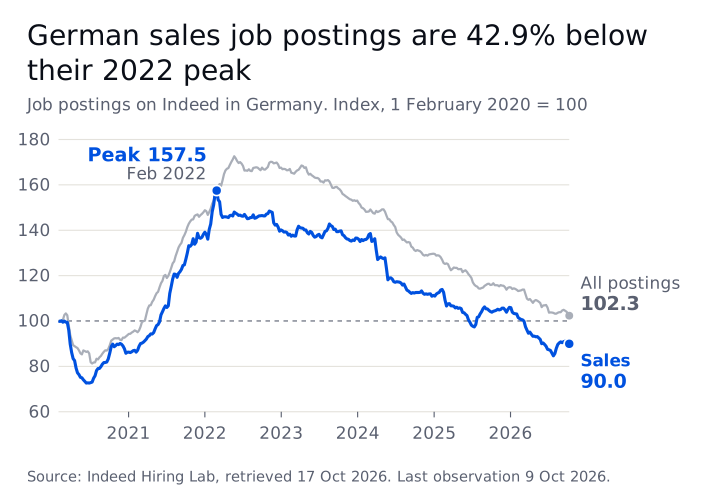
Hiring that seller may be easier now than a few years ago. On Indeed, job postings in Germany's sales category, which covers roles such as sales representative, were 42.9% below their February 2022 peak on 9 October 2026 [6].
Sales postings were also 10.0% below their level of 1 February 2020, while all German postings were 2.3% above it [6]. Fewer employers advertising for salespeople means fewer job ads competing with yours.
A practical checklist
- Can you describe your best customer in one sentence, using your won deals as evidence?
- Do the same five to ten objections come up, and do you answer them the same way?
- Has your pitch stayed the same for a full quarter?
- Do open deals stall when you are away for a week?
- Are your ideal customer profile, discovery questions, qualification rules, objections and pricing rules written down?
- Is the pipeline in a CRM, with named stages and exit criteria?
- Have you decided which job you hand over first, and which deals stay with you?
- If you sell abroad, does your first seller speak your buyers' language?
If most of your answers are yes, you are ready to hand over the first job. Start with prospecting.
Wardenclyffe Venture Studio works inside B2B technology companies on positioning, pipeline and the sales model, for a one-off setup fee and then a success fee. You can read how a partnership works.
Sources
- The Sales Learning Curve. Harvard Business Review, 2006. hbr.org
- Startups Need a Special Learning Curve for Sales. Stanford Graduate School of Business, 2006. gsb.stanford.edu
- 2025 B2B Buyer Experience Report. 6sense, 2025. 6sense.com
- Founding Sales, chapter 11: Sales Hiring. Peter Kazanjy, 2020. foundingsales.com
- How To Transition from Founder-Led Sales: Why Most Get It Wrong and How to Get It Right. SaaStr, 2025. saastr.com
- Indeed Job Postings Index: job_postings_by_sector_DE and aggregate_job_postings_DE (CC BY 4.0), retrieved 17 October 2026. Indeed Hiring Lab, 2026. github.com
Share


